Minolta MC W.Rokkor-SG 28mm f/3.5: The Practical Wide Angle Between Two Eras
The Minolta MC W.Rokkor-SG 28mm f/3.5 is not a prestige lens. Its strength is quieter: a useful 28mm view, durable early-1970s construction, and a rendering style that works across winter landscapes, city streets, and black-and-white studies.
The Minolta MC W.Rokkor-SG 28mm f/3.5 is not a prestige lens. Its strength is quieter: a useful 28mm view, durable early-1970s construction, and a rendering style that works across winter landscapes, city streets, and black-and-white studies.

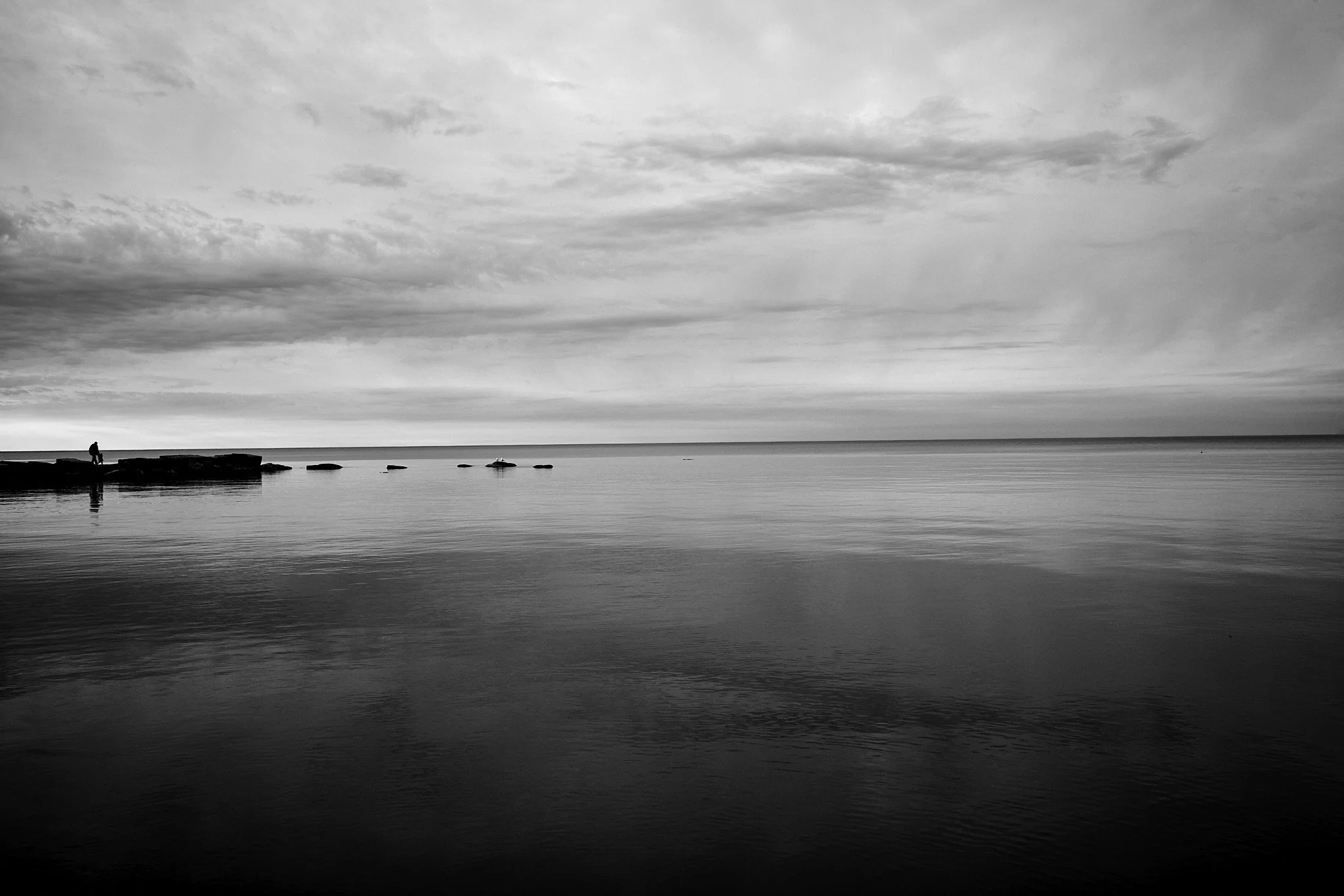
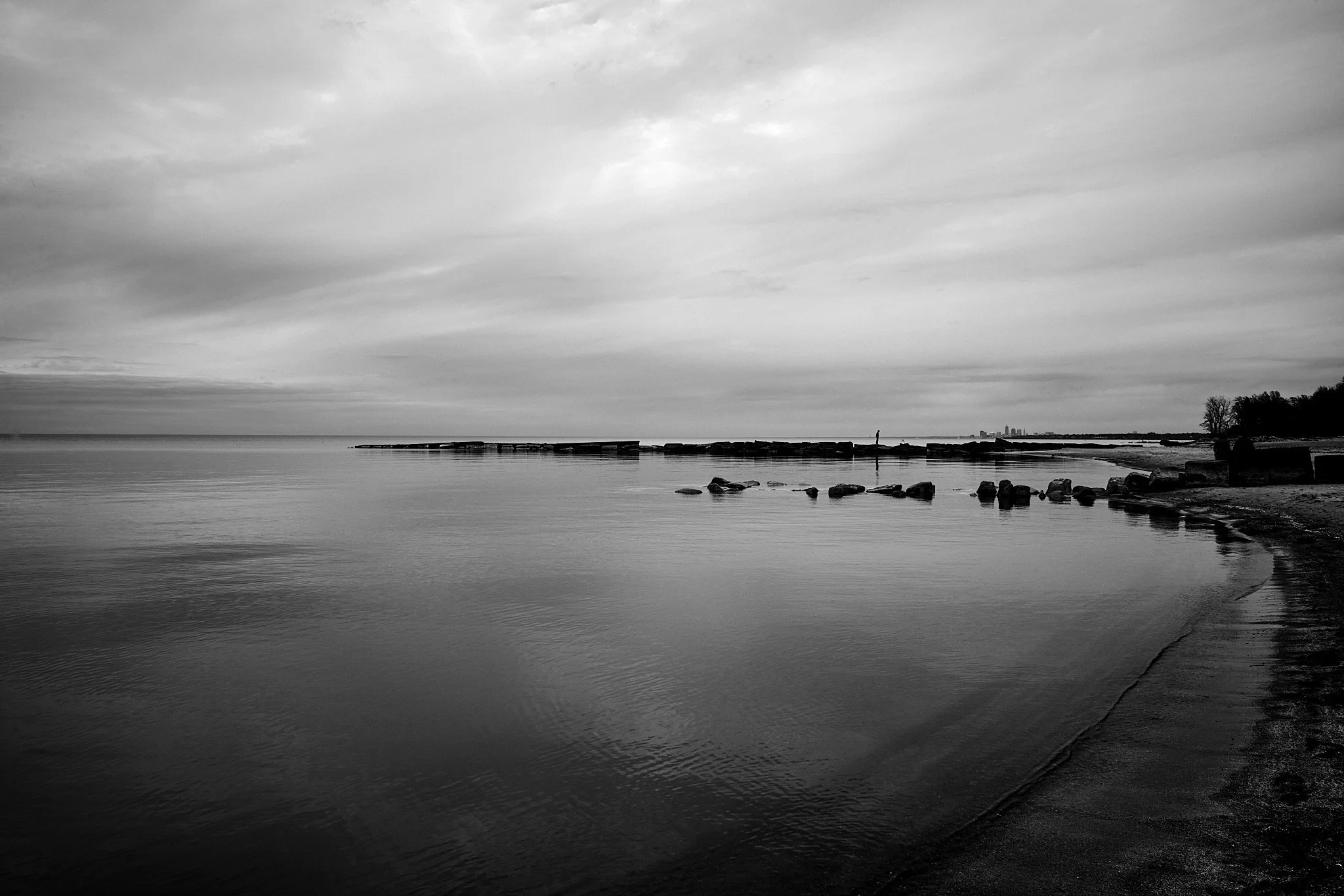
Fisherman on Lake Erie at dusk.
The Minolta MC W.Rokkor-SG 28mm f/3.5 is easy to overlook. Its f/3.5 maximum aperture seems modest, especially in a catalog where faster lenses naturally draw more attention. But 28mm was one of the most useful wide-angle focal lengths of the manual-focus era: broad enough to show the environment, but not so wide that every photograph depends on exaggerated perspective.
This lens was built for that middle ground.
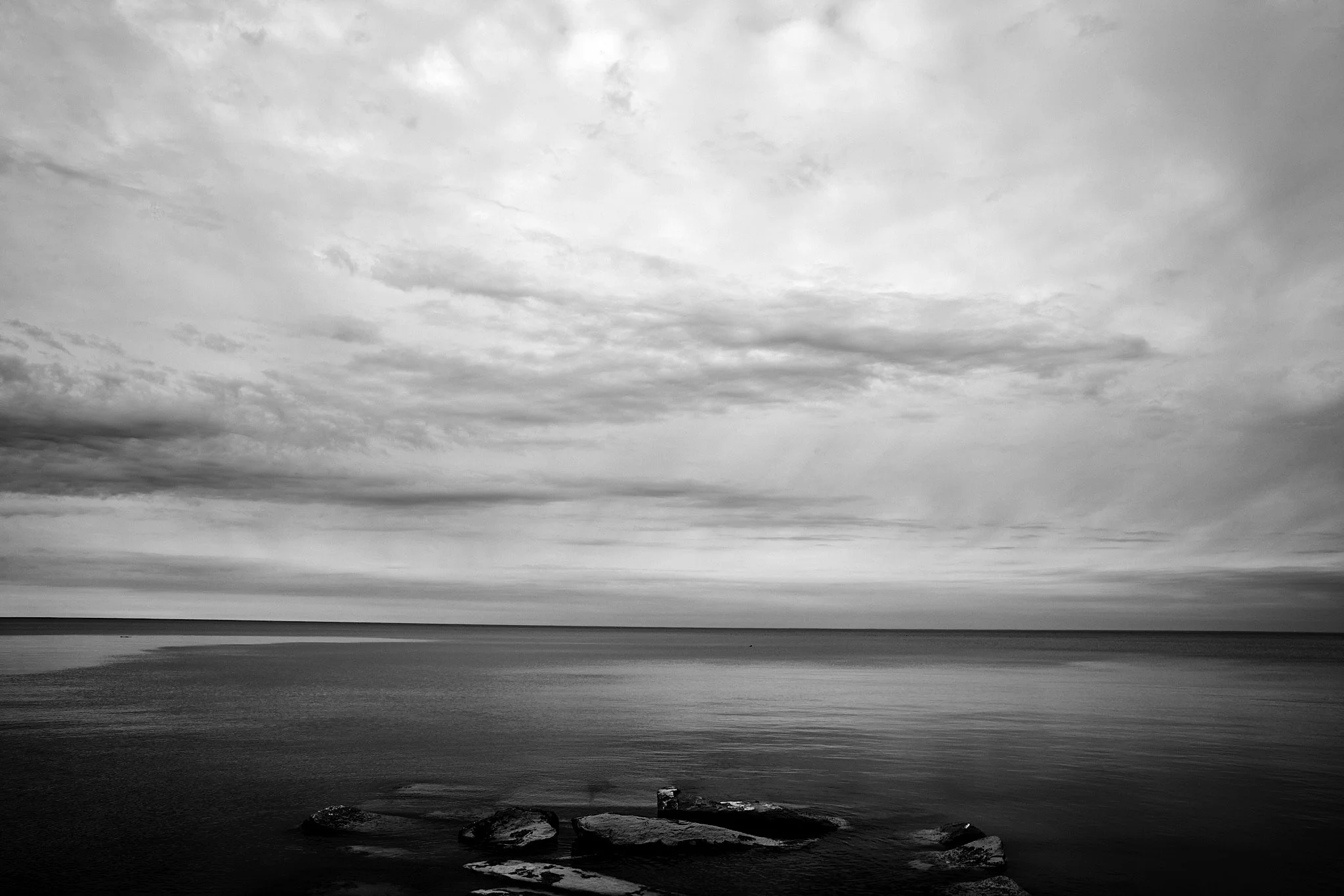
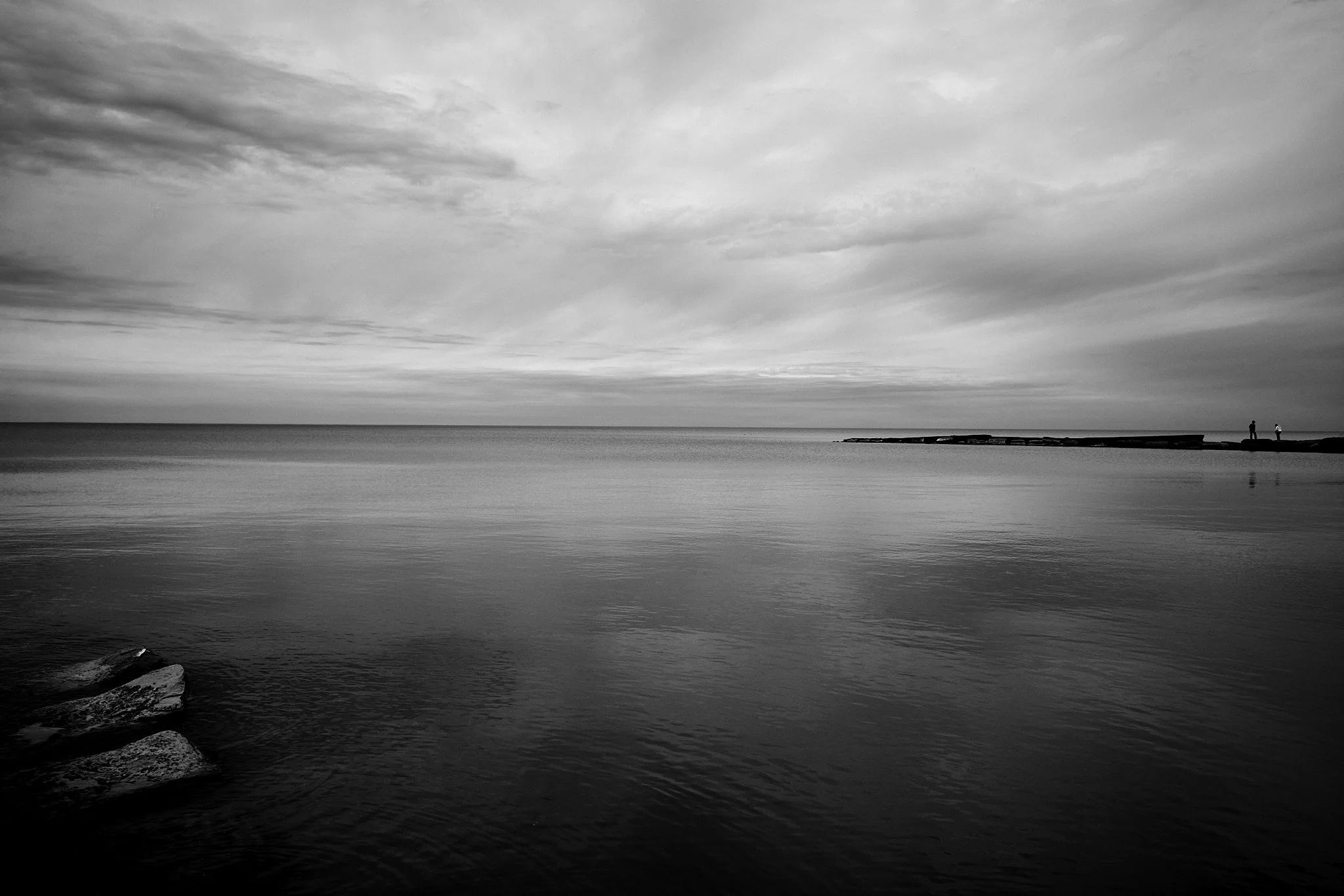
What stands out is not an exaggerated “vintage look” or lack of “digital sharpness,” but how naturally the lens handles space. Foreground objects can carry real weight while the distance remains connected to them. In black and white, the midtones retain separation. In color, the subdued winter blues, whites, and earth tones remain distinct without becoming harsh.
Wide, but still controlled
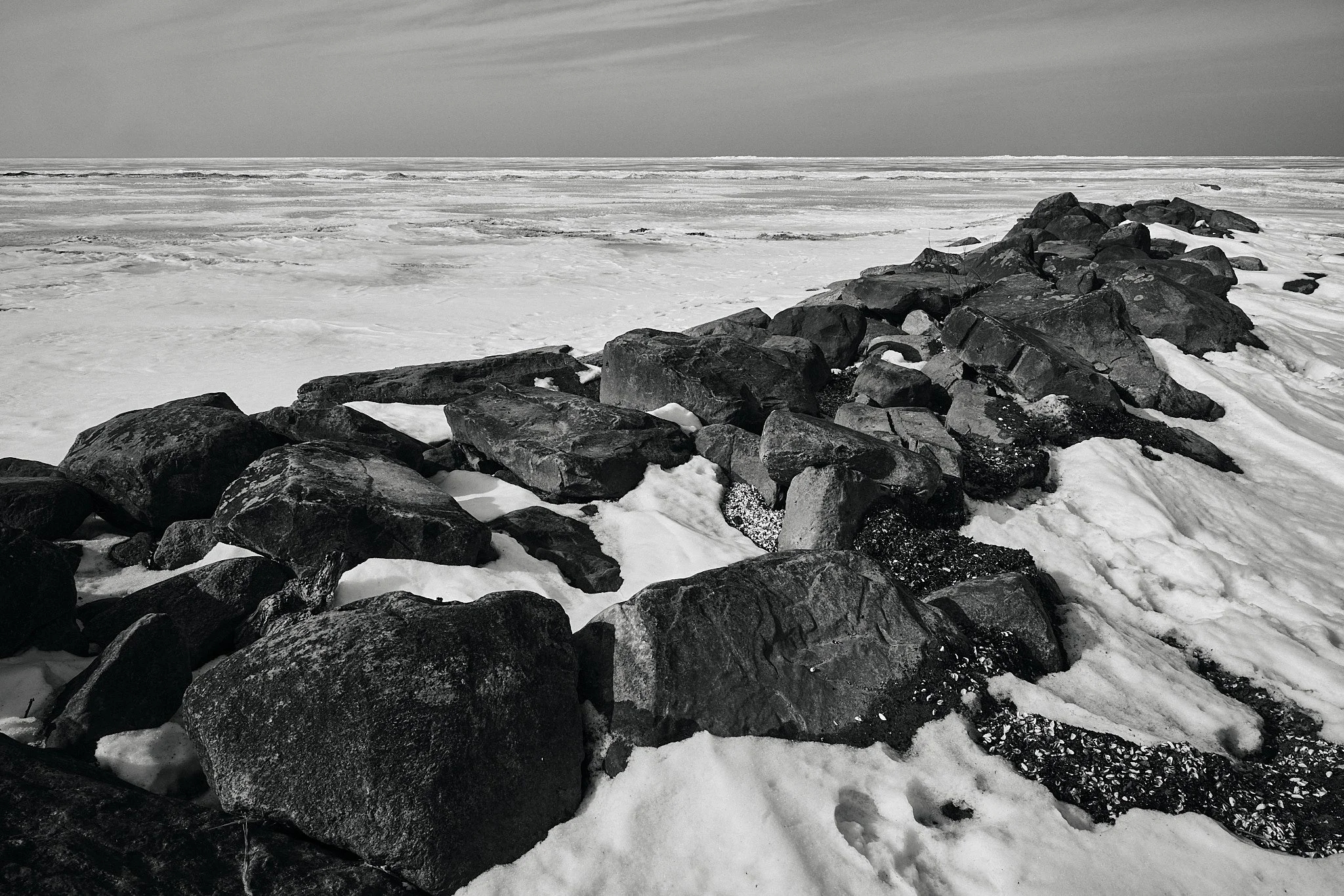
At 28mm, position matters more than magnification. Moving a few feet forward can transform a rock, curb, tree, or patch of ice from a minor detail into the structure of the photograph. The focal length rewards getting close enough for the foreground to establish scale, then allowing the background to explain where that detail exists.
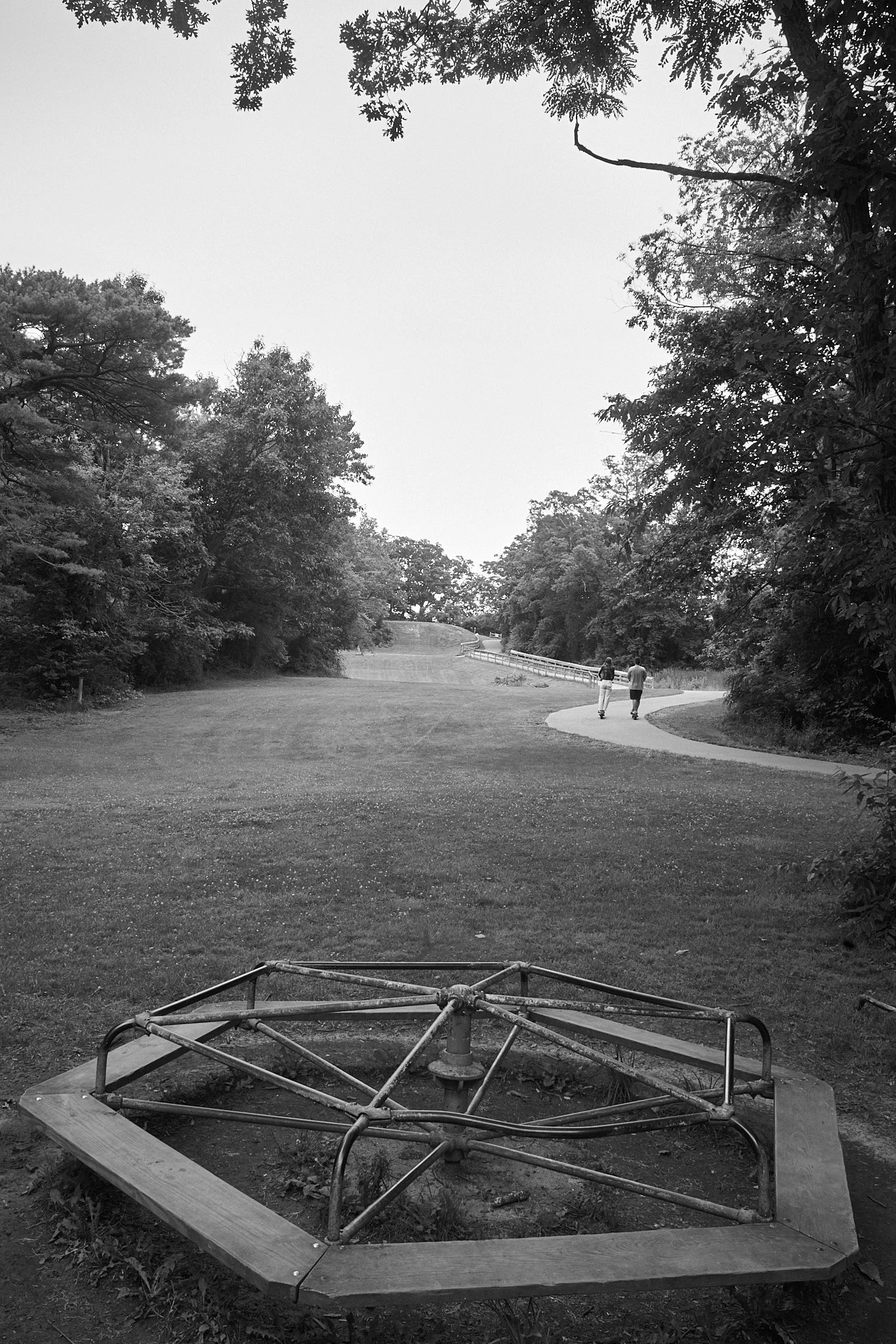
Just a reminder, a slice of childhood memory to hold to and remember.
In the photograph above, the rocks form a path through the frame toward the frozen lake. The perspective is clearly wide, but the horizon does not feel pushed into irrelevance. The near and far parts of the scene remain connected. That balance is one of the reasons a practical 28mm lens can be more useful than a more dramatic ultra-wide.
The lens focuses to approximately 0.6 meter and uses a 55mm filter thread. Neither specification is unusual, but both fit its role within the Minolta SR system: compact enough to carry, familiar to operate, and suited to landscapes, architecture, street photography, and general travel.

NYC, May 2026
A frozen winter landscape shows another strength of the focal length. The frame can hold a large amount of texture without losing the overall shape of the ravine. Small differences in blue, green, grey, and off-white remain visible across the ice, while the dark banks keep the composition contained.

Rocky River, Ohio, 2026
A lens carried across Minolta’s design transition
The SG marking on the front ring was not simply a decorative model suffix. Minolta used a two-letter code to identify optical construction, and SG indicates seven elements arranged in seven groups.
Specialist Minolta chronologies place the MC II version of this lens around 1970. That version used a short, knurled metal focusing grip and a silver aperture ring. Around 1973, Minolta carried the same basic seven-element, seven-group specification into the newer MC-X body, adding a rubber focusing grip and black aperture ring. North American examples could carry the Rokkor-X name, while other markets generally retained Rokkor.
This is why two lenses with the same focal length and aperture may look noticeably different while still belonging to the same optical generation. Rokkor-X was primarily a regional branding distinction, not proof of a different optical formula.
Around 1975, Minolta introduced a smaller five-element, five-group 28mm f/3.5 that focused more closely. That later lens belongs to the same focal-length family, but it should not be cataloged as the same design simply because the basic name remained familiar.


Why it still matters
The Minolta MC W.Rokkor-SG 28mm f/3.5 was not Minolta’s fastest or most prestigious wide-angle lens. It was the practical option—moderate in speed, durable in construction, and broad enough for everyday use. Its history also captures an important transition in Minolta design, from the metal-grip MC II style to the rubber-grip MC-X generation before the optical formula changed in the middle of the decade.
Today, it remains appealing for the same reason. It does not ask every scene to become a spectacle. It encourages the photographer to move, organize the foreground, and pay attention to the relationship between an object and the space around it.The lens records the scene without turning it into a demonstration of wide-angle distortion.
For more technical information and vintage-lens research, visit Brass & Glass: https://brass.glass/gear/minolta-mc-rokkor-28mm-f35

Minolta MC Macro Celtic 50mm f/3.5: The Affordable Macro That Was Still Pure Minolta
The Minolta MC Macro Celtic 50mm f/3.5 is an unassuming lens. It lacks the better-known Rokkor-X name, its maximum aperture is a modest f/3.5, and the Celtic branding can make it appear to be a third-party alternative.
It is none of those things.
The Minolta MC Macro Celtic 50mm f/3.5 is an unassuming lens. It lacks the better-known Rokkor-X name, its maximum aperture is a modest f/3.5, and the Celtic branding can make it appear to be a third-party alternative.
It is none of those things.
The Celtic macro was a genuine Minolta lens, made for the company’s lower-priced North American product line during the mid-1970s. Beneath the value-oriented branding was a serious close-up lens built around a six-element, four-group optical design, with focusing down to 0.23 meter and approximately half-life-size reproduction without additional accessories.
More importantly, it remains an enjoyable lens to use today where the practical purpose remains intact. The lens is compact enough to carry, mechanically satisfying to focus and capable of moving between ordinary photography and serious close-up work.
Its appeal is not based on rarity or exaggerated claims about a magical vintage signature. It comes from the combination of useful magnification, deliberate manual operation and a rendering style that encourages careful attention to color, distance and background.
For a lens designed as the affordable option, it has aged remarkably well.
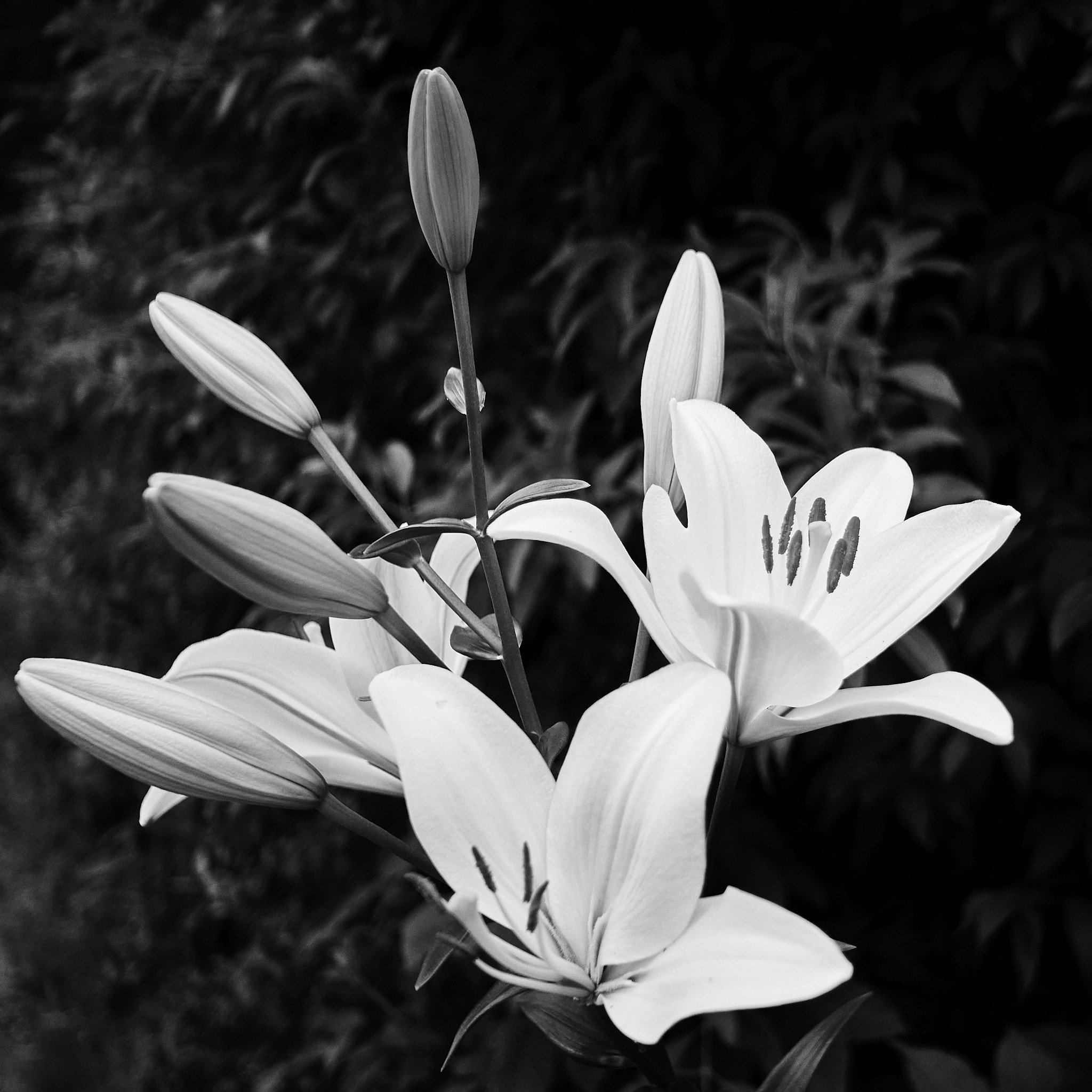
The images included with here were created with the Celtic 50mm on a Sony A7R III. Landscape images have that distinctive, modest sharpness when captured at F8 and above with a pleasing color rendering. The difference becomes apparent as the lens is focused closer.

At short distances, depth of field narrows rapidly. The subject remains clearly defined while nearby details gradually dissolve into color and shape. Because the maximum aperture is f/3.5, the lens does not depend on an extremely wide aperture to create separation. Instead, much of its character comes from working distance, subject placement and the transition between focused and unfocused areas.
Half life-size without an extension tube
The Celtic macro reaches approximately 1:2 reproduction on its own. That means an object measuring roughly 48 by 72 millimeters can fill a 35mm frame.
Minolta also offered a matching Life-Size Adapter that allowed the lens to reach 1:1 reproduction.
The lens focuses as close as 0.23 meter, although that measurement is taken from the film plane rather than from the front of the lens. The actual space between the subject and the lens is therefore considerably shorter. This is well suited to stationary objects, but can be challenging when photographing insects or other subjects that are easily disturbed.
The long focusing movement is part of the appeal. Fine adjustments can be made deliberately, and the physical act of focusing feels precise rather than hurried. On a mirrorless camera, magnified live view makes that process considerably easier than it would have been through a 1970s viewfinder.

Vintage lenses can sometimes preserve subtle differences in hue and surface texture that are rendered more aggressively by highly corrected modern optics. The Celtic macro’s moderate contrast can allow color relationships to remain visible without every edge appearing excessively sharpened. The result depends heavily on the background. A complicated scene can remain visibly structured, while a carefully chosen background can become smooth and painterly.
Celtic sounds like a separate manufacturer, but Minolta’s own system literature described Minolta/Celtic and Rokkor-X as two families of genuine Minolta lenses.
Celtic was the lower-priced line, while Rokkor-X occupied the premium position. The distinction appears to have involved branding, finish, coating and market position rather than the use of an outside optical manufacturer.
The Celtic macro shared the major published specifications of the contemporary MC Macro Rokkor-X: six elements in four groups, 0.23-meter minimum focus, 55mm filter thread, 325-gram weight and the same overall dimensions.
That does not prove the two lenses were identical in every optical or mechanical detail. No definitive Celtic-specific prescription or parts comparison has yet established complete equivalence. It does show that the Celtic was based on Minolta’s established macro-lens concept rather than being a simplified generic substitute.
Specialist catalog research places the model’s introduction in 1974. Minolta literature dated March 1976 still listed the lens, although some references describe the broader Celtic generation as ending in 1975.
The most defensible description is that the lens was introduced in 1974 and remained documented in Minolta literature through March 1976. The precise end of manufacturing is not known.
The photographed specimen carries serial number 2556408. Another recorded Celtic macro has a nearby serial number, 2555973, supporting the existence of a 255xxxx serial group. Minolta did not publish a reliable serial-number chronology for the model, however, so the number cannot be used to assign an exact year.
The Minolta MC Macro Celtic 50mm f/3.5 is historically interesting because it represents an effort to make specialized photography more accessible.
Macro photography could serve scientific, technical and commercial purposes, but it was also increasingly attractive to advanced amateurs interested in natural history, collecting and close observation. Minolta’s Celtic line offered those photographers genuine system lenses without requiring them to purchase the company’s premium Rokkor-X versions.





For more information, including technical specs, visit us at: https://brass.glass/gear/minolta-mc-celtic-50mm-f35-macro